
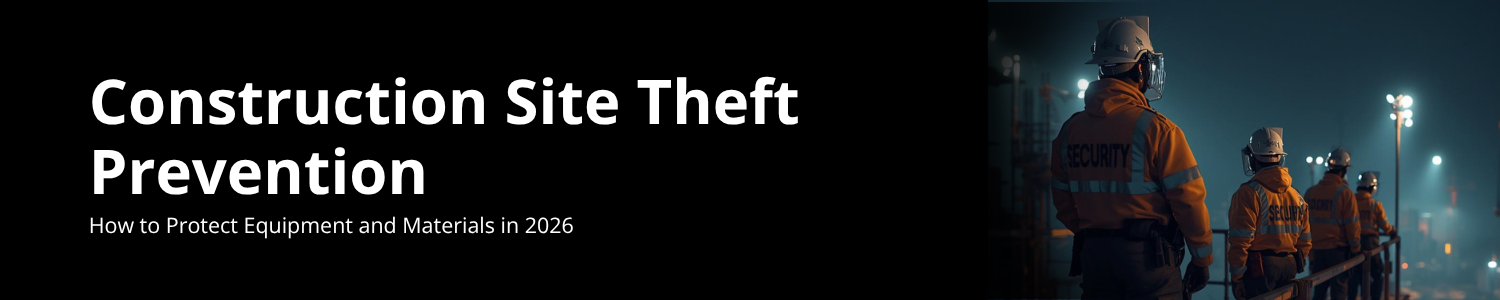
Construction sites are among the most vulnerable environments in the country when it comes to theft and vandalism. Open perimeters, high-value equipment, remote locations, and overnight downtime create conditions that criminals actively exploit.
The numbers reflect it. Equipment theft alone costs the construction industry an estimated $300 million to $1 billion annually, and that figure does not account for the downstream impact including project delays, insurance claims, increased premiums, and the operational chaos of replacing stolen materials or machinery mid-project.
For construction directors and project managers, the question is no longer whether security is necessary. It is whether the security approach you are using is actually working.
Why Traditional Security Falls Short on Construction Sites
Most construction sites rely on one or more conventional approaches, all of which have significant limitations.
Fencing and perimeter barriers provide a physical obstacle but offer no active deterrent or monitoring capability. A determined thief can breach a fence in minutes.
Security guards are expensive, difficult to staff on remote or multi-site projects, and can only be in one place at a time. Guard turnover in the construction sector runs high, leading to inconsistent coverage and accountability gaps.
Fixed cameras require power infrastructure and permanent mounting, neither of which is readily available on active construction sites. They also capture footage reactively, meaning they record incidents but do nothing to prevent them.
Motion-activated lighting is a low-cost deterrent that provides minimal protection against organized theft operations.
None of these approaches are designed to actively prevent an incident from occurring. They are reactive by nature, and reactive security does not protect your equipment or your project timeline.
The Real Cost of Construction Theft Goes Beyond the Equipment
When a piece of equipment is stolen from a job site, the financial impact extends well beyond the replacement cost.
Project delays create significant downstream expense. Sourcing and delivering replacement equipment can take days or weeks, pushing out milestones and triggering contractual penalties. Labor productivity loss compounds the problem as crews sitting idle while waiting for equipment or materials represent a direct cost that is rarely captured in theft reporting.
Insurance implications accumulate over time as repeated claims drive up premiums and can affect your ability to secure coverage for future projects. The administrative burden of filing police reports, processing insurance claims, and coordinating replacement pulls project leadership away from core responsibilities.
On high-visibility projects, theft incidents create reputational exposure that can affect future contract opportunities.
A single significant theft event can cost a project two to three times the replacement value of the stolen item when all downstream impacts are accounted for.
What Effective Construction Site Security Looks Like in 2026
The construction projects that have seen the sharpest reductions in theft and vandalism have made a fundamental shift in their security approach, moving from reactive documentation to active deterrence.
Visible, Intelligent Surveillance Presence
Mobile surveillance units deployed at key access points create an immediate visual deterrent. When criminals can see that a site is actively monitored with cameras, lighting, and clear signage, the risk calculus changes. Most theft is opportunistic. A visible security presence moves that opportunity elsewhere.
AI-Powered Threat Detection
Modern mobile surveillance systems use on-device AI analytics to detect human activity in real time, not just motion. This means the system can distinguish between environmental movement and an actual intrusion, reducing false alarms and ensuring that genuine threats trigger an immediate response.
Two-Way Audio Deterrence
When a system detects unauthorized activity, it can automatically broadcast a verbal warning directly to the individual on site. This audio intervention is one of the most effective deterrence tools available. It makes clear to the intruder that they have been seen and that a response is underway.
Remote Monitoring and Rapid Response
AI detection paired with remote monitoring enables a security response within seconds of an event, regardless of the time of day or the location of the site. This is particularly valuable for remote or multi-site projects where on-site guard coverage is impractical.
Rapid Deployment and Repositioning
Unlike fixed infrastructure, solar-powered mobile surveillance units can be deployed on a new site in hours and repositioned as the project evolves. Security coverage moves with the work, from foundation to framing to finishing.
Questions Construction Leaders Should Be Asking About Their Security
If you are evaluating your current approach, here are the questions worth asking:
If someone entered your site tonight at 2am, how quickly would you know? Does your current security approach prevent incidents or just document them? Can your security coverage be repositioned as the project evolves? What is the total cost of your current approach including guard staffing, turnover, and incident response? How would a major theft event affect your project timeline and client relationships?
If the answers are uncomfortable, it may be time to rethink the approach.
Protecting Your Construction Site With Tower Patrol
Tower Patrol’s mobile surveillance systems are purpose-built for the realities of active construction environments including remote locations, evolving site layouts, and the need for security infrastructure that deploys fast and scales with the project.
Our systems are solar powered, cellular connected, and equipped with AI analytics capable of detecting activity up to 300 feet. They deploy in hours, require no fixed infrastructure, and can be repositioned as your site evolves.
The result is active, intelligent deterrence that protects your equipment, your materials, and your project timeline without the cost and complexity of permanent infrastructure or around-the-clock guard staffing.
[Request a consultation to discuss your project’s security needs →] request a demo.
Leave A Comment